
Why Most MVPs Fail Before They Launch
Most MVPs don't fail because of bad ideas. They fail because founders build too much, validate too little, and delay feedback. Learn the most common mistakes and how to avoid them.
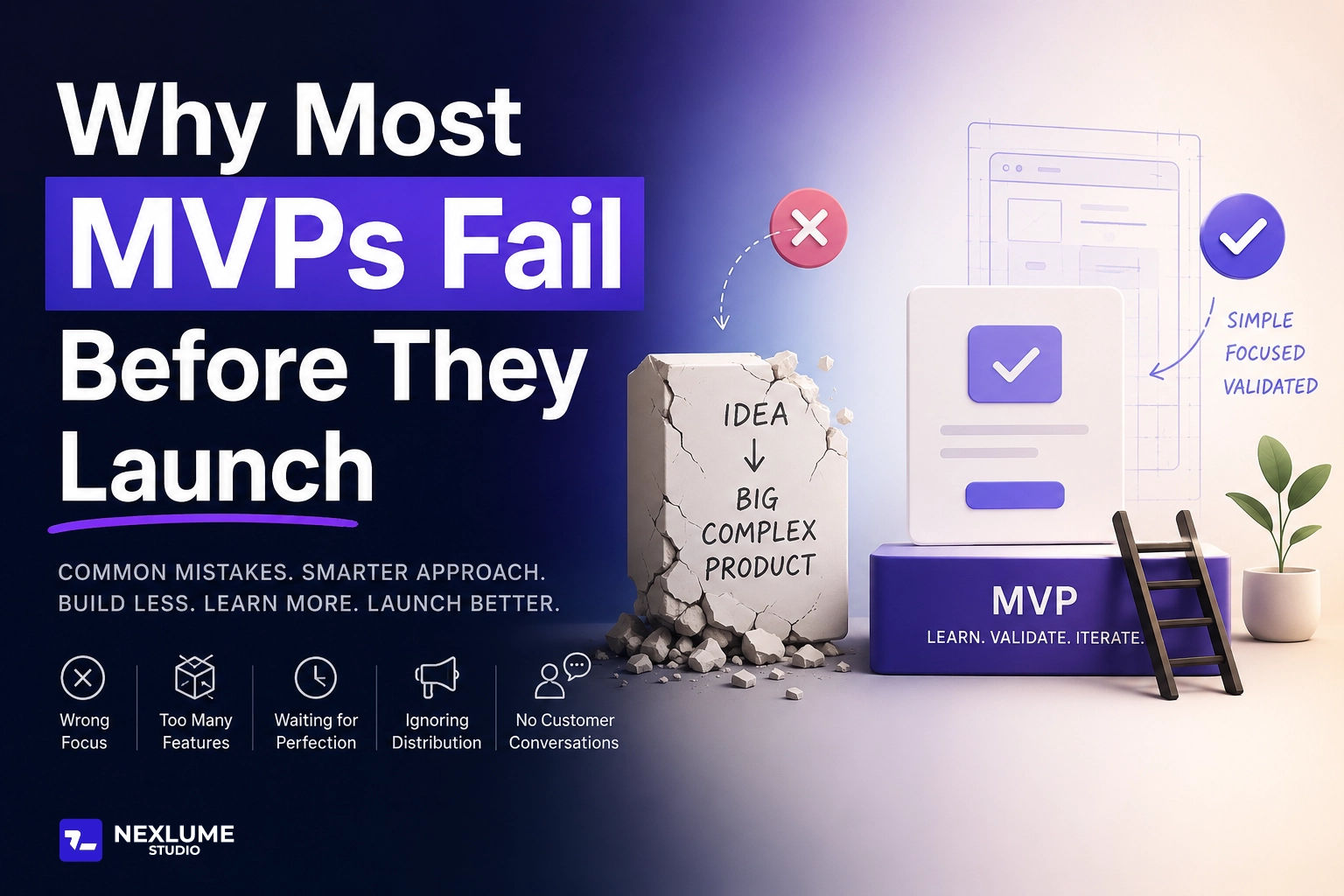
Why Most MVPs Fail Before They Launch
Building an MVP is easier than ever.
Launching one successfully is not.
Every year, thousands of founders spend weeks or months building products that never gain traction. Not because the idea was bad. Not because the technology failed. But because the team focused on building instead of validating.
This guide explains the most common mistakes founders make when creating an MVP and how to avoid them.
What an MVP Actually Is
Many founders misunderstand the purpose of an MVP.
An MVP is not a smaller version of your final product.
An MVP is the smallest version of a product that allows you to test a business assumption.
The goal is not to impress users.
The goal is to learn.
If your MVP cannot answer a meaningful question about your market, users, pricing, or positioning, it is not an MVP.
Mistake #1: Building Too Many Features
The most common mistake is trying to launch a complete product.
Founders often create:
- Complex dashboards
- Authentication systems
- Team collaboration features
- Advanced settings
- Analytics panels
- Multiple user roles
before they have validated whether anyone actually wants the product.
A good MVP focuses on solving a single problem extremely well.
Ask yourself:
If I could only keep one feature, what would it be?
Build that first.
Mistake #2: Designing for Scale Too Early
Scalability is important.
But scalability is rarely the first problem.
Many founders spend time designing architectures capable of supporting millions of users before acquiring their first ten customers.
Premature optimization slows learning.
Instead:
- Build simple systems
- Reduce complexity
- Optimize only after real usage appears
Your first goal is validation, not scale.
Mistake #3: Waiting for Perfection
Perfection is expensive.
Every week spent polishing a product delays feedback.
Real users provide information that no amount of planning can replace.
The faster you ship, the faster you learn.
The faster you learn, the better your product becomes.
A product that launches imperfectly often outperforms a product that never launches at all.
Mistake #4: Ignoring Distribution
Many founders believe:
If I build something valuable, people will find it.
This is rarely true.
Distribution should be planned before development begins.
Examples include:
- Content marketing
- SEO
- Communities
- Email newsletters
- Partnerships
- Social media
- Direct outreach
Without distribution, even a great product can fail.
Mistake #5: Building Without Customer Conversations
Customer interviews remain one of the highest leverage activities for early-stage founders.
Speak directly with potential users.
Understand:
- Their current workflow
- Existing frustrations
- Tools they already use
- Budget constraints
- Buying behavior
These conversations often reveal opportunities that analytics cannot.
A Better MVP Framework
Instead of asking:
What should we build?
Ask:
What do we need to learn?
Then identify:
Assumption
The belief you're testing.
Example:
"Freelancers want pre-built client onboarding systems."
Experiment
The fastest way to validate that belief.
Example:
A landing page with a waitlist.
Success Metric
The outcome that determines whether the assumption is valid.
Example:
100 qualified signups within 30 days.
Next Action
What happens if the experiment succeeds or fails.
This approach reduces wasted effort and accelerates decision-making.
The Real Goal
An MVP is not a product milestone.
It is a learning milestone.
The purpose of an MVP is to reduce uncertainty.
Every feature, screen, and workflow should contribute to that goal.
The fastest-growing products are rarely the most feature-rich products.
They are the products that learn the fastest.
Final Thoughts
Before building your next feature, ask yourself:
- Does this help validate an assumption?
- Does this help a user achieve a result?
- Does this improve learning?
If the answer is no, it may not belong in your MVP.
Focus on clarity.
Focus on speed.
Focus on learning.
Everything else can come later.